
Hope and its beautiful cousins
I have been thinking about the differences in the ideas of faith and hope. Advent, our friend Blake reminded us last year, is a season that always begins in exile. We read the Old Testament prophets writing from inky darkness, their enemies terrifyingly close, centuries of disappointment collapsing downward in a crushing, overwhelming wave. Hopeless.
Even so, they write toward the only star in the sky they can see.
Advent is often described as a season of hope, but I wondered why it wasn’t thought of as a season of faith. Faith, after all, seems like the underpinning of all this about a Messiah born to save the world. All the things we believe. Hope, faith, belief–they’re all cousins, right?
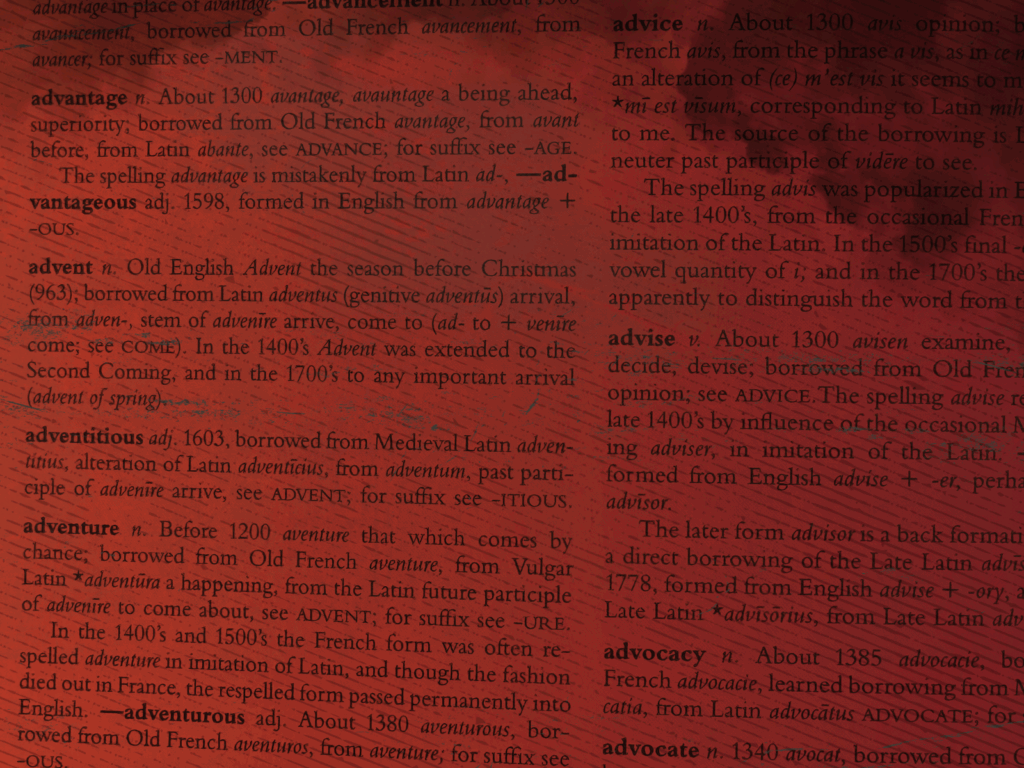
Etymologically, kind of, not really. I pulled off the thick dictionary in the great room, blew off the dust, and spent time plumbing the family histories of these English words.*
Faith first appears in the form that we know it around 1250; its roots run through Old French toward the Latinate fides. Trust.
Trust is older, probably before 1200. Scandinavian roots. A term that emerges from cold weather, Old Icelandic and Swedish and Norwegian and Danish words sister up to it. Words that imply confidence and reliance.
Confidence (before 1400) springs from confide; con (completely) fides (trust). Reliance bubbles out of rely, which as a verb originally meant to gather or rally and only later (in 1574) “to depend.”
Depend: de (from, down) and pend (to hang, to be suspended); as a verb it appears in English around 1410.
Jesus issued two commandments: love God with your heart, soul, and mind; love your neighbor as yourself. All the other laws depend on–hang from–these two commandments.
And hope?
Here we find a fissure between hope and faith: hope implies expectation, while faith rests on belief. Hope, from before 1200, unfolds from an Old English word that could also mean wish or desire. Something shifts on the seesaw when we move from faith to hope. Not that we make demands with hope, but that we stand on different ground. Expectation.**
Hope is a statement spoken before God but uttered in the tone a child takes before a parent, where there are no question marks but instead occasional glances to see if what was just said could in fact be true.
There is something bold in being hopeful. Where does it all come from?
Paul writes: “we glory in our sufferings because suffering produces endurance, and endurance produces character, and character produces hope. And hope does not put us to shame.”
Faith is how humanity solves for doubt. It finds the bridge across the dark chasm of not knowing and allows us to rest our burdens on something stronger than pure invention.
Hope, though, is a propelling force–kinetic energy for the soul.
Today I’ll assemble our little homemade Advent wreath we keep on the breakfast table, and tonight over supper we’ll light the first candle. There are four weeks of Advent and four candles we’ll light and four themes to dwell upon: peace, joy, love and, at the very beginning, hope. Not faith, not belief. Hope.
As a holy season, its important to remember Advent was invented by the early church. It’s not something borne of prophesy or Gospel; rather, it is a teaching tool to help believers better frame their understanding of God and the divine birth. Something beautiful, then, that even the early believers felt entitled to expectation. Hope might be a stronger muscle than faith. Perhaps the earliest Christians felt it was the right foot forward for Advent.
Advent is an even older word than the others we’ve examined: it makes its mark in Old English, rooted in those fifth and sixth century traditions, blossoming from the Latin venire, to come. What exciting cousins: advent, adventure, invent, convent(ion). Advent: the arrival.
So begins this wonderful season. We await the arrival of the child Christ, the Savior born among the darkest of nights, blanketed by inevitable death, invented by God to convene his people in Heaven. An adventure of hope.
O come, o come, Emmanuel–and ransom captive Israel.
Amen.
* I am reminded of the perils of losing our language in this flattened, digital world. There was something wonderful about avoiding Google and ChatGPT and instead pulling down the thousand-page Barnhart Concise Dictionary of Etymology, a volume that Kelly gave me decades ago, and spending an hour looking up and reading about words and engaging the analog, nerdy English major gear still in my brain. Words, even words that we assume are synonyms, came from different places and mean different things. When we demand language to move faster and faster and require less and less mental energy, we risk losing those nuances. Yes, language changes over time–the dictionary of etymology is printed record of that–but when we examine the words given to us by God, it feels important to trace that history. HERE ENDETH my curmudgeonly commentary.***
** It isn’t until 1817 that expect is used as a euphemism for pregnancy, but isn’t it a lovely echo for Christmastime?
*** Haha, kidding, it never ends, it’s me, I’m the curmudgeon.
Ruth Ann Olp
It is the first day of Advent I have lit the first candle, sitting in my kitchen window. I will place it in a wreath tomorrow, but for tonight I will just enjoy the glow. Thank you for your lesson. I am always interested in history, especially related to my faith.
Judith Evelyn Henderson
Lots to think about. Thanks James.
Bruce
Thanks for the lesson, James. This would make a great topic for the Thursday breakfast. It is interesting that the old style of celebrating advent was to be low key until Christmas Day. The 12 days of Christmas don’t start until the 25th. It may only be the need for merchants to make all their sales before the end of the year that has created the modern Christmas. That and our lack of patience. And stick bubbly on AI.