
“He was a good man.”
This weekend, in Minneapolis, an American citizen was killed in broad daylight by federal agents. It was the second such killing this month.
Saturday’s murder claimed the life of 37 year-old Alex Pretti, a nurse who worked at the city’s VA medical center. Pretti was on the street documenting ICE agents with his cell phone camera, following them as they continued their weeks-long mission to capture and deport undocumented immigrants.
The first killing, which claimed the life of Renee Good, followed a similar encounter in a Minneapolis neighborhood. Good and her partner had confronted ICE agents on a snowy street, blocking the way through with their car. As agents surrounded her SUV, Good began to pull away, prompting one agent to fire his service weapon at close range into the car, killing her. Later, the Department of Homeland Security claimed the agent fired in self-defense, fearing for his life as Good’s SUV pulled forward. The DHS secretary claimed Good was a domestic terrorist.
Video evidence of the scene paints a picture that—at best—strains to confirm such a report. As ICE agents circle Good’s SUV, one stands directly in front of her car. But as Good begins to pull away, it’s clear she turned the wheels of the car away from the agent.
Video from the scene where Alex Pretti was killed, however, leaves little doubt. Pretti can be seen in multiple videos standing in the street approaching ICE agents with his cell phone held out, recording. As agents force two other protestors out of the way, one female protestor is shoved to the ground and doused with pepper spray or some other chemical irritant. Pretti steps in to help the woman, but he’s quickly surrounded by multiple ICE agents, who pin him down while striking him. An officer removes a firearm from Pretti’s waistband—a gun he had legally purchased and was permitted to carry. A second later, they open fire on him. He died at the scene.
Once again, high-ranking members of the federal government rushed to cast Pretti as a terrorist and assassin who approached ICE agents armed and intending to inflict casualties.
These statements are grossly inaccurate at best and intentional lies meant to cover-up the killing of an American citizen at worst.
The United States government–under any administration–has the legal authority to enforce the nation’s immigration laws. While reasonable people can disagree as to the practicality or morality of immigration laws and policies, it isn’t illegal to detain and deport an undocumented person. Immigration and Customs Enforcement has existed as a federal bureau since 2003; its origins date back to the Immigration Act of 1891. Democratic and Republican administrations alike have carried out deportation operations.
Even so, we have to confront what happened here: two American citizens, Renee Good and Alex Pretti, are dead. Neither committed a capital offense. Neither was charged with a crime, nor did they receive a trial by a jury of their peers. They were not fugitives, they were not armed insurgents, they were not domestic terrorists. They were simply citizen protestors and observers, engaging their American rights to free speech.
At worst, both should have simply been detained, arrested, and charged with obstruction, resisting arrest, or other reasonable offenses. The use of lethal force against them wasn’t just excessive, it was unconstitutional.
And equally troubling, federal authorities quickly moved to deny state officials access to both investigation scenes. After Renee Good was shot while driving away, agents involved with the shooting left the scene, while others blocked state investigators from approaching. (Later, the FBI took command of the investigation.) On Saturday, Minnesota’s Bureau of Criminal Apprehension took the extraordinary step to secure a search warrant for the area where Alex Pretti was shot–somewhat absurd, given he died on a sidewalk, clearly a public area–yet they were still prevented from gathering evidence.
The deaths of American citizens and the violation of their constitutional rights at the hands of federal officials merits investigation. Our country’s precipitous political environment and the deepened fracture of its citizens offer very little hope for any trustworthy resolution. Antagonists on the right and left produce only a deafening roar.
Earlier this week, I wondered aloud if Renee Good might have been naive to the danger she faced confronting the ICE agents who ultimately shot and killed her.
In the face of a second death of a citizen at the hands of federal agents, I don’t think it’s naive to demand accountability. But for the first time in my life, I’m left wondering how anyone in our nation’s dysfunctional discourse can demand as much without grave fear of retribution. What assurance might we have that doing so wouldn’t bring us to a similar fate?
At a recent vigil honoring Renee Good, Rob Hirschfield, the Episcopal Bishop of New Hampshire, asked his clergy to prepare for a “new era of martyrdom.” Such a bold statement sent a shiver down my spine–but of course, an important side effect of salvation is to embolden the courage of the dying.
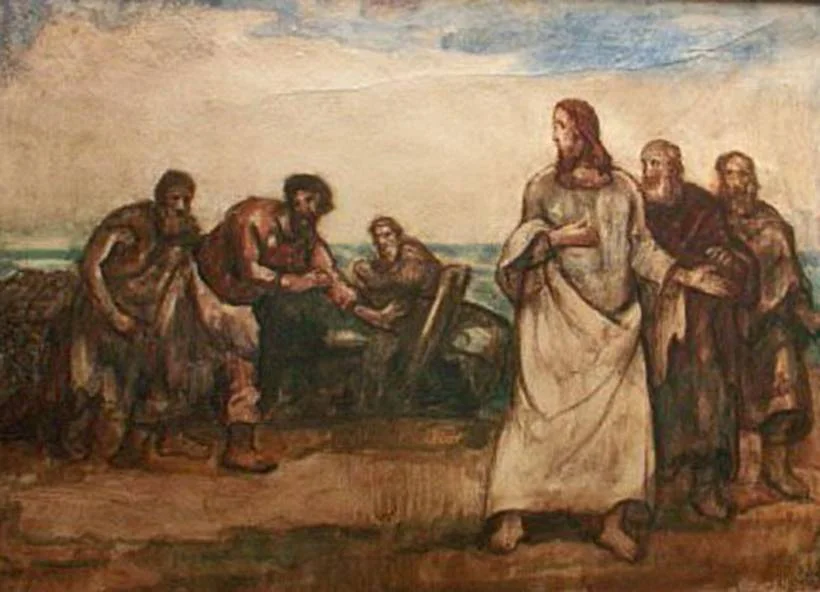
Our church service was cancelled today due to the impending ice storm, so we watched the online service from our church back in Statesville. The Gospel reading told the story of Jesus calling his disciples, when Christ promised to make them fishers of men. Father Brad noted that call extends to us, too.
But the mission that God sets out before us won’t be easy. One of the hymns* they sang, “They Cast Their Nets in Galilee,” offers this haunting stanza:
The peace of God, it is no peace
but strife closed in the sod.
Yet, brothers, pray for but one thing:
the marvelous peace of God.
In the middle of a cold winter rain, far away in North Carolina, it feels there’s little to do. Upstairs, the kids are playing. A fire in the woodstove warms the hearth. A pot of marinara sauce fills the air. Soon, it will be suppertime.
I think of the prayer I might offer over dinner, of whether our children might hear those words quietly spoken before God and take them to heart. Whether they, too, might recognize the need for grace and love in the face of deep distress and troubling times. And whether they understand where their father stands on the matter.
Perhaps now is a good time for fathers to speak out. “Please get the truth out about our son,” Alex Pretti’s father wrote in a statement.
“He was a good man.”
Of note: the hymn “They Cast Their Nets in Galilee,” which is primarily found in the Episcopal hymnal, is based on a poem by William Alexander Percy. A Mississippi native who grew up in a privileged family around the turn of the century, Percy became known for his efforts to help African Americans during the Great Flood of 1927. His father, LeRoy Percy, ultimately obstructed those efforts. The coincidence of the hymn author’s moral courage is worth noting.
Leave a Reply