

Granted, I’m typing on a computer, beaming these words from the kitchen bar where I’m drinking coffee, over the wifi, across the great beyond to my website, which dutifully records and posts them somewhere, and presumably you are out there somewhere, reading this on a device of your choosing, a laptop or phone, reading line after line against the glare of an LED screen.
But I am a human, and so are you.
At least, dear readers, that’s true for most of you, or hopefully much of you. There’s an analytics plugin installed on my website that suggests at least a handful of you are bots. Not actual robots, of course, just a thing that scrapes my site, which I think means makes a copy, tucking it away somewhere. It conjures up a funny idea that out in the electron cloud that is this website and all the websites in existence, I have a little devoted following of robot readers. A robot fan club, perhaps. And that they occasionally stop by to see what I’ve been up to.
In reality, this website “sits” somewhere on a server tucked quietly in one of the many data centers that have sprung up all over the world, the likes of which have existed for decades now but so recently have attracted negative attention and organized protestations for their newly explosive development. This website is just a modest collection of blips and bloops, ones and zeroes mapped out on a hard drive nestled among millions of them.
It’s amazing to consider it on the whole–the entire infrastructure that sorts the moments in between my sitting down in the kitchen and having a few thoughts and a cup of coffee and then you reading them. Quite a thing.
I remember an early experience on the internet from when I was young, the first time finding my way into a chat room. Early chat rooms–what a scene. Chat rooms in the 1990s were primitive in design and regularly bespoke in character. To experience one for the first time was thrilling: there on the screen before you was a collection of others, other humans sitting at their own terminals (all of them bulky, heavy desktop computers), all of us in real time reading and typing back and forth with strangers across the world. It felt like discovering an entire universe that you did not know existed*.
Such early excitement carried me (a geriatric millennial or by-the-skin-of-my-teeth X-er, you choose) into the internet age. I fondly remember ICQ**, a tiny program you could run in the taskbar of your Windows machine represented by a little flower that would blink when someone sent you a message. If your computer had speakers plugged into it, ICQ’s message alert would chime a cartoonish “uh-oh!” sound. These messages weren’t anything more than little dashes of correspondence, the earliest iterations of texts or tweets, and you had to be there at your computer to read them and type something back.
It was difficult, maybe not by design, but certainly by the limitations of technology. Everything was painstakingly slow. It was an ice age ago. TV was still square. You could stay in a hotel and wake up and open your door and find a copy of USA Today right there on the floor waiting for you, gratis. If you wanted to chat with someone on ICQ, you more or less had to go to the computer (and the computer was always in the same place, often in the “computer room” or where ever its spot was designated) and turn it on and wait and wait, and then you would connect to the internet (itself a chirpy little adventure) and then log in–and only then, only if the other person had waded through the same steps at the same time, could you chat.
And it worked! It worked, and we were patient enough to endure it because there was something magical to it. Those early experiences felt wonderfully human. The thrill was in connecting with people who were so often beyond your normal reach. For a teenager growing up in the country, it was cool.
The early days of Facebook were similarly buzzy. In the late aughts, a great many posts on my “wall” were from high school or college friends I’d lost touch with, most of them “it’s great to hear from you!” conversations. Now, when I click through Facebook “memories,” those posts appear like bizarre, out of context relics–because back then you’d write something on somebody’s wall, and they’d write back on your wall, and back and forth you went in conversation. The “on this day” memories function just gives you one side. Piecing them together these days is sometimes fun, sometimes embarrassing.
These days…my, oh my.
Today I stood at the computer that’s at my desk at work and composed entirely on my own an email to send to a group of people. I did not use the AI. Using generative AI to revise or edit or list or summarize or bullet or make better feels increasingly ubiquitous in the workplace. Today, I decided to forgo all of it and just write it out, just write like I knew how to do, write like I’ve been trained to write, because I am a damned competent writer with a degree in English education and a professional background in teaching composition to young people, someone with an entire doctoral dissertation that was successfully defended and published and now sits somewhere in the cloud-that’s-really-a-data-center-probably-in-the-midwest.
I wrote an email by myself. I winced once when I pecked out a sentence that had a rhetorical structure commonly observed in ChatGPT outputs. And then I backspaced through the entire sentence and rewrote it to sound purposefully different.
I find myself doing that more often when I write purposefully independent of the GPTs. It is a rage against the machine. I try to leave thoughtful artifacts anymore, idiosyncratic flourishes I would almost certainly edit out at other points in my life as a writer but now leave in there as markers that a human being was here, little signs, trail blazes tacked onto trees among the thick groves.
I read in the newspaper (online of course, no print editions at my hotel door anymore) that middle school children are increasingly making friends with chatbots online, and it’s making them lonelier. Their emerging and developing brains crave real human connections. The bots are holding them back.
Thomas said as much the other day, pronouncing in a very thirteen-year-old-boy way that YouTube was really now just a cesspool of AI slop. It impressed me that he would willingly display such revulsion. Perhaps the kids are going to be okay.
I mean…hopefully. God, I hope so. We have to avoid the exterminating-the-human-population-by-accident scenario***. Or the little-AI-bots-out-in-all-the-data-centers-collectively-decide-to-end-us scenario.
On a night like this, a naive thought: surely it’s too hard for Claude to wipe us all out. An early autumn chill has settled into our mountain valley, and the evening temperatures fall to the forties, and when I let the dogs outside before bed I can see my breath and hear the last of the crickets chirping across the holler and stare up at the clear sky full of stars****. Short of nuclear winter, I assume, the AI brigade could cause a lot of pain, but surely it’s too much to take us all out.
Maybe, maybe not–say the odds-makers.
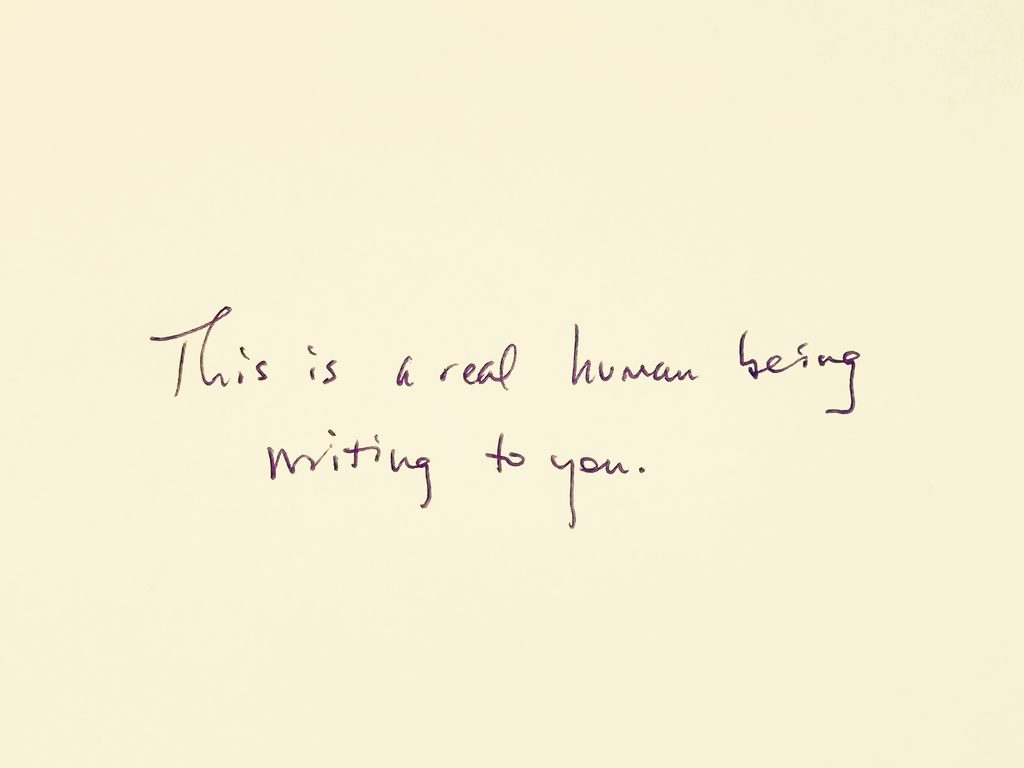
Maybe. It’s possible we’re in the twilight before the end times. If that’s the case, friend, please know: this is a real human being writing to you.
Not a chatbot, not a generative AI agent, not a computer program on the one hundred fifty-eighth row, eleventh rack, fourth shelf of a data center in Des Moines.
A human. One of many who came of age in the advent of this world-wide-web that’s wrapped us up in its brilliance, trillions and quadrillions of lines of code and fiber optic cable and wifi signals coiled about our lives like boa constrictors. Breathless in the tightening grasp, the suffocating pain a surprise, bright flashing conjuring the nostalgic, syrupy memories of everything we’ve given to it, the Instagram photos and reels, the gigabytes of emails we couldn’t delete, the gigabit folders full of thumbnails and cookies and GIFs, the keychains and multifactor and backups copied across the Google Cloud, the Amazon Cloud, the iCloud, the syncing infinite monthly installments leeching everybody’s online checking accounts. The algorithm’s sharp sniper rifle aimed straight between your eyeballs to ensure you don’t struggle too much.
It sounds bleak. It is.
Maybe not. My biggest surprise is how quickly we seem to be over the slop, how the abiding attitude is earnestly bipartisan. How Bernie and Bannon agree on it. If nothing else, there is relief in seeing our kids’ growing disgust at the whole gambit. Maybe it isn’t too late.
Maybe one day we’ll wake up to find we’re all free. I chuckled the other day in conversation, dreaming out loud about how maybe, if we’re lucky, the ChatGPT uprising will simply wipe out all the bad stuff–it’ll explode the algorithm and sink the social media and CTRL+A all the slop and press DELETE. It would be the ultimate reboot, leaving us a vast, open plain to try again.
Anybody out there? This is a real human being writing to you, and I pray and hope that you are a real human being reading it. Not an Anthropic agent assigned to intake my prose and use it to model another rhetorical profile.
A human reader, one who will see it and hear my words in your mind, who might even push air out through your lips and speak them out loud, to vibrate the atmosphere with the sound of blessed, human language. Who will speak and write back and know that you have shifted my existence with them, that you’ve rearranged the synapses in my mind. That you’ve warmed my heart.
Notes
*The other day, Annie noted that she had joined a Minecraft server full of friendly people and that they were chatting back and forth using the comms feature inside the game and that it was “cool” to interact with total strangers. She is 10, and I really never thought about it, and it’s both terrifying–she’s 10!–and thrilling to share that experience with her.
**ICQ launched nearly 30 years ago in November 1996 and officially shut down in June of 2024. It’s hard to believe it was still going as recently as it was. Apparently the “uh-oh” sound is heard a lot around gas stations.
***I love the early “paperclip factory” model of how an AI system would kill us all–wherein we set up an AI to make paperclips, and it takes its job very seriously, and it depletes the entire planet’s resources in its mindless frenzy to complete its task and consequently we all die. Silly yes, but one illuminating example of how some innocuous thing like an autonomous paperclip factory leads to human annihilation.
****Naturally, as I was in the midst of star-gazing, one of Elon Musk’s million little internet satellites raced across the sky. Bastard, I thought.
Leave a Reply