

Annie ran a fever last night. She woke up feeling cool and much better, but we’re at home this Sunday morning. It was a cold start–the coldest all of this early autumn season–and a light frost fell. Even so, the sun was up over the mountain by the time I had my second cup of coffee, and I bundled up and sat outside on the deck, the sun full on my face, and shut my eyes, and marveled at the orange glow of my eyelids.
The lectionary reading this morning led me to Exodus. In the thirty-third chapter, Moses is up on the mountain, again, meeting with God. From far away, the Israelites simply see Moses go to his meeting place with God, a place where a thick cloud surrounds.
This is long after Moses led his people out of Egypt, after the plagues, after Moses threw his staff to the ground and watched it turn into a serpent. After God held back the waters of the sea for the Israelites, only to let them cascade back inward to drown their persecutors.
And it is after God’s people entered the desert, after the Lord sustained them with manna. After Moses went up to receive the commandments, after they made the golden calf. After Moses destroyed the tablets and they all knew they were in big trouble.
In short, Moses and the Israelites–and God–have been through quite a bit together, not much of it necessarily comfortable. God tells Moses to leave this place, to go to the promised land, but God says he will not go with them, because… well, because the Israelites have really pissed him off, and God is not entirely sure he won’t get mad and destroy them all. In fact, he has threatened this before. Bunch of stiff-necks, he said. Ought to wipe them out, God said. Moses talked God out of it.
Now, after being told to leave, Moses pleads with God to go with them: “If your Presence does not go with us, do not send us up from here. How will anyone know that you are pleased with me and with your people unless you go with us? What else will distinguish me and your people from all the other people on the face of the earth?”
God replies that he finds favor with Moses and will do as Moses asked. But Moses, boldly, then asks to see God. “Show me your glory,” he says.
I wonder if anyone heard God sigh.
It would be the natural, human response of a parent nearing the point of exasperation with a child. Perhaps I am leaning too much into humanizing God, at least in the form he presented to Moses. But God, then, uses human terms to respond to Moses’s forward request.
“You cannot see my face, for no one may see me and live,” he says. “When my glory passes by, I will put you in a cleft in the rock and cover you with my hand until I have passed by. Then I will remove my hand and you will see my back; but my face must not be seen.”
Living in the mountains of western North Carolina is a blessing, and among those blessings is the wilderness that blankets about. The cold front that whipped through this weekend brought a dusting of snow to the high elevations, including at LeConte Lodge. I sent a photo they’d posted online to Thomas–we’d hiked there not quite a year ago.
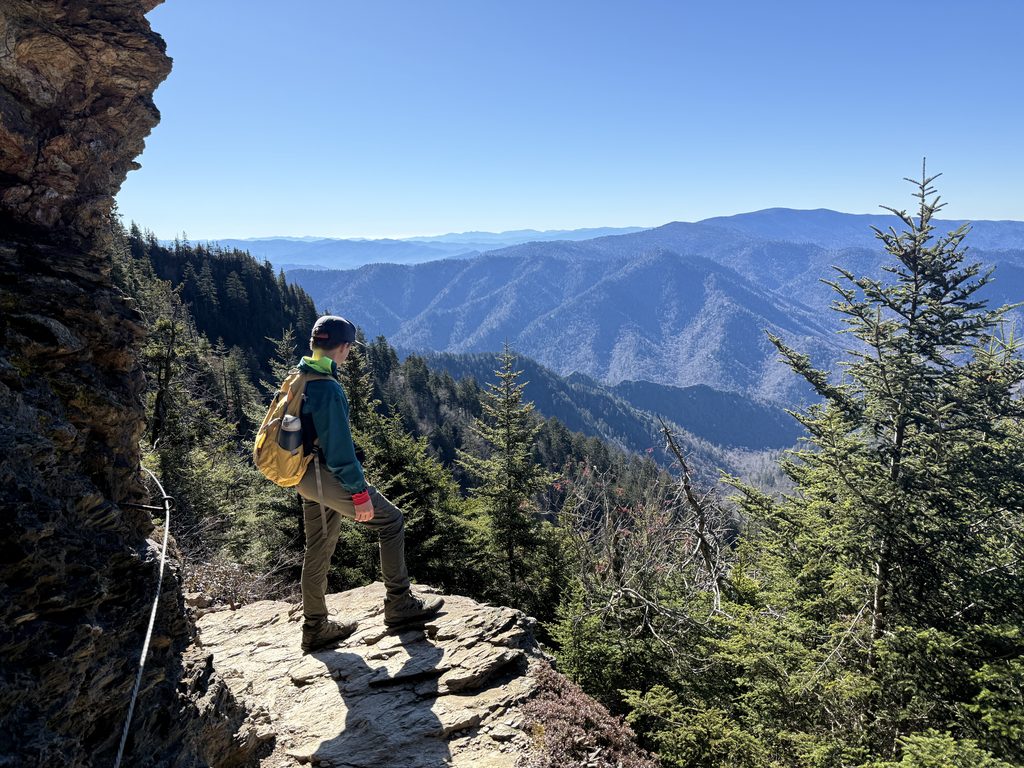
The hike to Mount LeConte can feel tenuous, as the trail clings to the side of the mountain and at times feels more like a ledge. The photo at the top of this post is of Thomas from our hike. LeConte is not Everest, but it’s enough of a challenge to leave a novice hiker like me feeling vulnerable.
Along the way, the ancient rocks that form the mountain range have split away, creating occasional niches or overhangs. The hike up LeConte can sometimes mean braving weather that appears suddenly, out of nowhere. What’s happening at the base isn’t always what’s happening up top. I imagine some of those shelters of rock could come in handy in such circumstances.
This is sort of what I think about when picturing Moses and God up on the mountain: Moses, perhaps not realizing just what he has asked from God, wedging into a tight space, barely big enough to cover him, filled with who knows what creepy-crawly things there might be out in the wild, while God covers the narrow opening with a brilliant, gentle hand.
God and Moses get a do-over. Moses receives the commandments a second time–God makes Moses write them on the tablets this time–and then Moses enters the rock cleft and glimpses God. When he comes down from the mountain, his face is so brilliantly illuminated that it made the others afraid.
The Israelites did not leave for the promised land, at least not immediately. Instead, they built a tabernacle, and when it was completed, the cloud that had covered the place where Moses and God had met descended into it, and they knew God was with them. If the cloud was over the tabernacle, the Israelites stayed put. When it left, they followed it.
Moses knew that if God didn’t go with them, they were doomed. I don’t know the tone he used when he beseeched God’s accompaniment, but I imagine it might have been frantic. Go with us, he begged, knowing God’s anger with them threatened utter destruction if God did.
Here in two weeks, we’ll celebrate All Saints Day, a day of remembering Moses and all the saints departed. After that, it’s the final weeks of Ordinary Time in the church calendar.
Then, of course, we’ll enter the season of Advent, the time we spend awaiting the holy birth, the long-anticipated arrival of Emmanuel, God the Savior, Jesus.
Emmanuel. God with us.
Leave a Reply